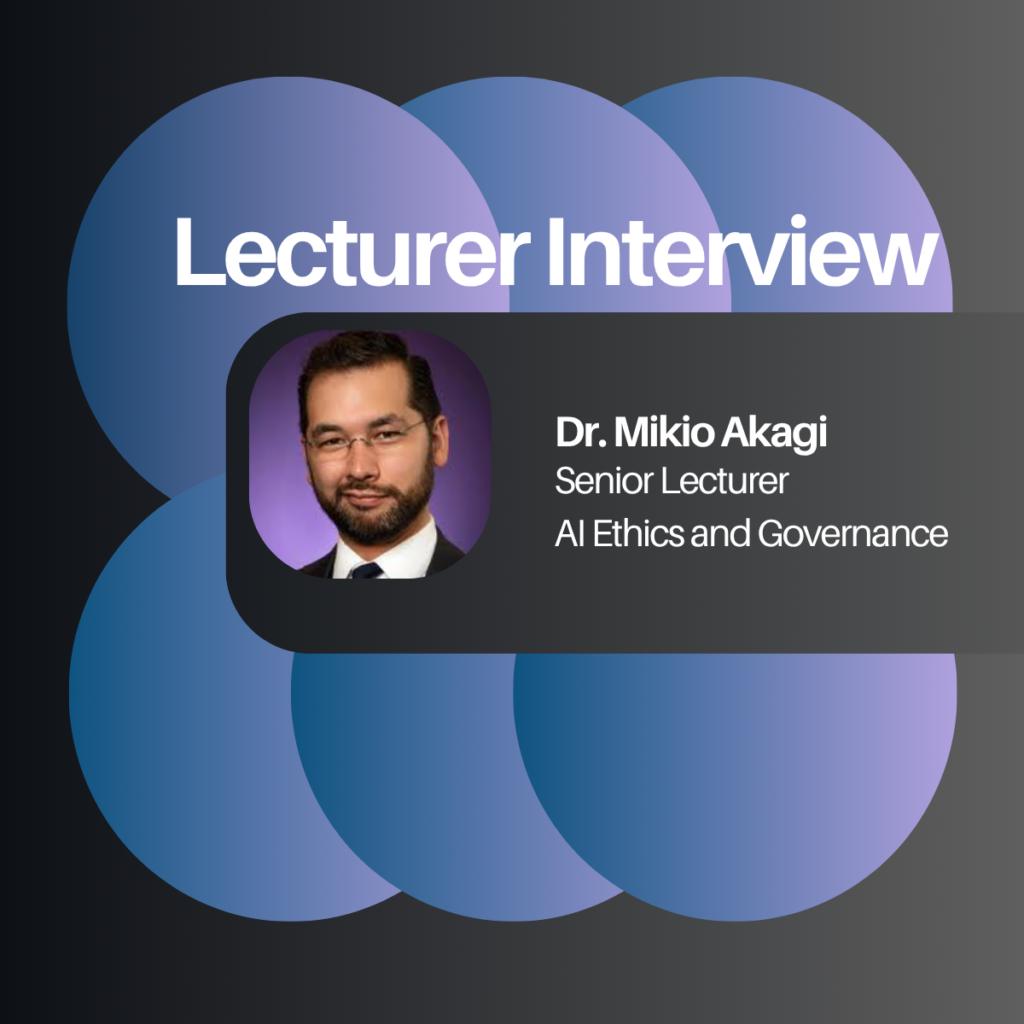
Mikio Akagi is a Senior Lecturer at Business Technology Academy, where he teaches the AI Ethics and Governance course. Before joining the Academy, he spent three years as an AI Ethics Consultant at Trilateral Research, advising clients including UNHCR, UKRI, and the Housing Agency across Ireland, the UK, and Europe on AI Act compliance and ethics assessments.
He previously spent six years as Associate Professor of the History and Philosophy of Science at Texas Christian University. We sat down with Mikio to discuss how AI governance is shaping the workplace, and why safety, data protection, and bias mitigation should sit at the centre of any AI project — the very issues his students learn to navigate on the course.
In the interview, he explains why good governance isn’t just a compliance exercise — it protects companies, improves AI outcomes, and builds trust with employees and customers alike. You can read the full interview below:
What is your background in AI?
I have been following developments in AI for over twenty years, most recently as an AI ethics consultant. I advised clients in Ireland, the UK, and Europe on how to identify and manage AI-related risks. I’ve also designed trainings for over a hundred organisations on various topics related to AI governance and responsible AI development. Before I was a consultant, I was an associate professor of the history and philosophy of science. I have a PhD in philosophy, and I’ve published research articles on topics like AI ethics, non-human cognition and bias.
What made you interested in a career in AI governance?
Personally, I wanted to focus on work that is ethical and socially responsible. AI tools have great potential to help people, but there is also a lot of empty hype and carelessness (and sometimes worse). I feel better about my day if I can spend my time helping others to avoid errors, minimise harms, and make AI tools more inclusive and helpful.
What are the key AI principles that executives should keep front of mind when implementing an AI project?
There’s a lot to consider, and it really depends on the details of the use case. I would say that that the top three principles are safety, data protection, and bias mitigation. First, ensure that whatever you’re doing, you minimise safety risks for users and other people who might be affected by your AI tools. Second, think about how to protect sensitive information like personal data or other confidential information. Finally, there are many kinds of biases that might harm people or undermine your business outcomes. There is no such thing as “bias-free” data or AI tools. Many biases can never be eliminated, so they have to be minimised and managed thoughtfully throughout the lifecycle of an AI tool.
Why do business executives need to learn about AI ethics and governance?
AI governance helps you to do the right thing, of course, and that’s its own reward. But proper governance also helps you to get the most out of your AI tools and investments. Tackling safety and privacy helps you to protect your company. Mitigating bias helps you to improve your services. Proper management of procedures and people helps you to improve consistency, support your employees, and keep people happy. Companies that invest more in AI governance are more likely to see better outcomes with their AI tools.
What skills do you need to succeed in AI governance?
One thing that makes AI governance challenging is that it can be difficult to predict how AI tools will be used. “AI” is a broad category that includes many kinds of tools, including large language models which can themselves be used for lots of different purposes. But students can improve their ability to identify risks by combining tools and practical judgment. We can provide students with tools like checklists and matrixes to help think through possibilities. But those tools still require AI governance professionals to make tricky judgments about practical constraints. We use case studies, discussions, and example exercises to help students improve their ability to make these complex judgments.
Why should someone consider a career in AI governance?
The demand for these roles is growing and expected to accelerate. AI tools are already everywhere, and they’re becoming more specialised, affordable, and necessary in many industries. The AI Act is beginning to shape the way AI tools are regulated in Europe and around the world. Business leaders are also learning that to make the most of AI tools, they need to do more than just let their employees use ChatGPT. There is a demand for professionals who can be a bridge between technical specialists, managers, and others.
Want to learn the Fundamentals of AI Ethics and Governance? Check out the Course details in the Courses Page above!
Business Technology Academy is a member of Aontas, the Irish National Adult Learning Organisation, Cyber Ireland, Ireland’s Cyber Security Industry Association and is accredited by the European Association for Higher Education