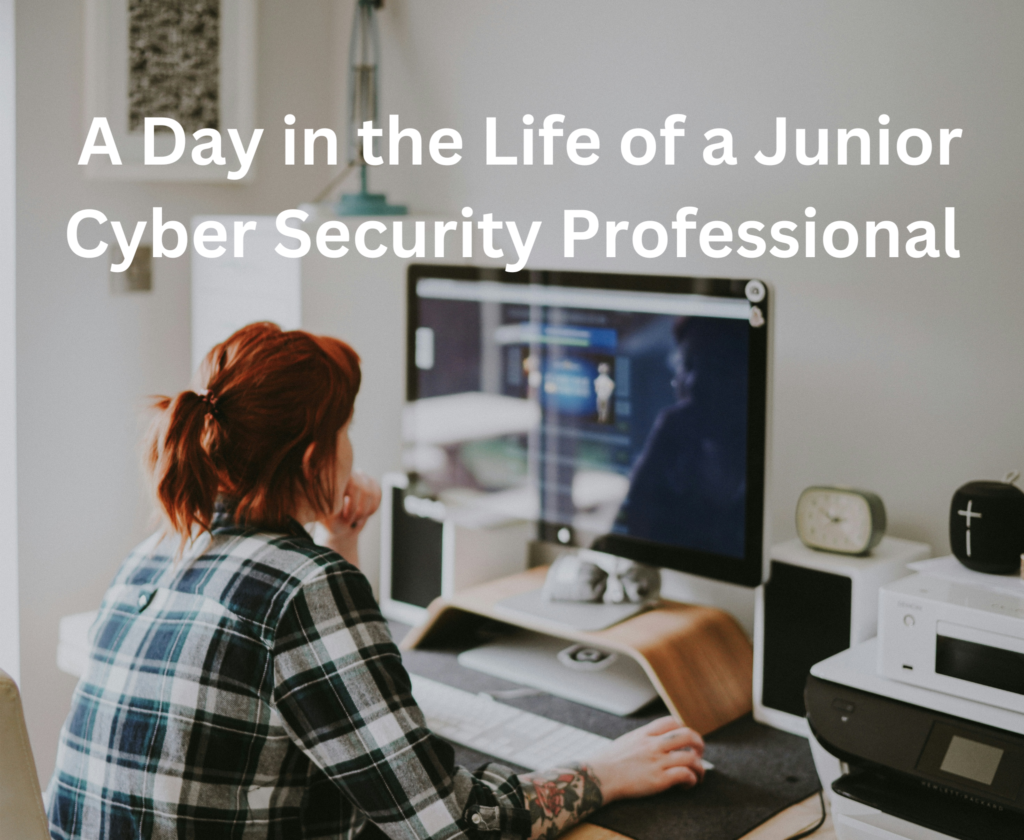
“Cyber security” can sound intimidating — like a job for hackers in hoodies, staring at scrolling green text in a dark room. In reality, it’s a lot more varied, a lot more people-focused, and a lot more learnable than the stereotype suggests. If you’re weighing up whether a beginner cyber security course is for you, here’s a realistic look at what the day-to-day actually involves — and specifically, what you’d be expected to do in your first job as a junior.
Starting the day: spotting what’s normal (and what isn’t)
A lot of the job comes down to pattern recognition. Every company’s computer network has a “normal” — the usual flow of emails, logins, and data moving around. Security teams keep a constant eye on this, watching for anything that breaks the pattern, like a login from an unusual location or a spike in unusual traffic.
As a junior, this is usually your job first. You won’t be expected to make the big judgment calls on day one — that’s typically a senior analyst’s decision — but you will be the one reviewing the overnight alerts each morning, working out which ones look routine and which ones need to be escalated. It’s a responsibility-building role: you learn by triaging real (if usually low-stakes) alerts under supervision.
This is why beginner courses spend real time on networking basics — not to turn you into an engineer overnight, but so you understand what’s actually happening when a computer talks to another computer. Once that clicks, the alerts on a screen stop being gibberish and start telling a story.
Dealing with scams — the human side of the job
One of the most common tasks isn’t technical at all: someone in the company forwards a suspicious email and asks, “is this real?” It might be a fake invoice, a message pretending to be from IT, or a link designed to steal a password.
This is very often a junior’s task specifically. Investigating reported phishing emails, checking the sender details and links, and confirming whether something is genuinely malicious is a common first responsibility — it’s low-risk to get wrong (you can always ask a senior colleague to double-check) and it teaches you the investigative habits you’ll use for the rest of your career. You may also be asked to help write the “here’s what to watch out for” reminders sent round to staff.
This is called phishing, and it’s one of the very first topics covered in any beginner course, because it’s one of the most common ways companies actually get attacked — not through complicated hacking, but through a well-worded, convincing email.
Making sure the basics are locked down
A surprising amount of cyber security is unglamorous maintenance: making sure passwords are strong, checking that multi-factor authentication (a second login step, like a code sent to your phone) is switched on, and reviewing who has access to what.
Juniors are frequently given this kind of maintenance work — auditing user accounts, checking that access permissions match who actually needs them, flagging any accounts that look stale or over-privileged. It’s not dramatic, but it’s exactly the sort of task a senior team member or CISO will hand to a junior to build up their attention to detail before trusting them with higher-stakes decisions.
Understanding encryption — without needing a maths degree
At some point most days, a junior professional will encounter encryption — the process of scrambling data so that even if someone intercepts it, they can’t read it.
You’re unlikely to be designing encryption systems as a junior — that’s specialist, senior-level work — but you will be expected to understand how it works conceptually, check that it’s being applied correctly (for example, confirming a company website is properly using HTTPS), and flag anything that looks unencrypted when it shouldn’t be. Beginner courses teach the concept first, before anything more technical.
A look at how attackers think
Every so often, a specialist team runs a penetration test — a safe, authorised attempt to break into the company’s own systems to find weaknesses before a real attacker does.
As a junior, you’re unlikely to lead one of these — penetration testing is usually a more senior or specialist role — but shadowing these sessions is a common and valuable task you’ll be given early on. You might be asked to help document findings, or follow up on making sure identified weaknesses actually get fixed afterwards. It’s a deliberate part of how juniors are brought up to speed: see the attack first, understand the defence second.
Planning for the worst — calmly
Occasionally, teams run a practice drill: “what would we do if ransomware hit our systems right now?” Walking through an incident response plan — who to contact, what to shut down, how to recover — is core security work.
Juniors are usually given a defined role within the plan rather than being asked to run it — for example, being the person who documents the timeline of what happened, or who contacts a specific list of people. It’s a good example of how junior tasks are scoped: clear, bounded, and supervised, while still being real responsibility rather than busywork.
The bit people forget: rules and regulations
Cyber security isn’t just technical — it’s also about compliance. In Ireland and the EU, that means understanding GDPR and how personal data has to be handled and protected.
This is another area where juniors often do the groundwork — keeping data-handling logs up to date, checking documentation against policy, helping prepare materials for audits — while a senior colleague or the CISO signs off on the bigger compliance decisions.
So — do you need to already be “techy” to do this job?
No. Every skill above is something a well-structured beginner course teaches from the ground up, assuming no prior background. What actually matters more as a junior is reliability, attention to detail, and a willingness to ask questions — you’re not expected to have all the answers on day one. Most of what a CISO or senior analyst hands to a junior is exactly the kind of bounded, supervised task described above: real work, real responsibility, but with room to learn.
If any of this sounds interesting, that’s usually a good sign a beginner cyber security course is worth exploring.
Business Technology Academy is a member of Aontas, the Irish National Adult Learning Organisation, Cyber Ireland, Ireland’s Cyber Security Industry Association and is accredited by the European Association for Higher Education